













CIC, IIC, ITE, and ITC Hearing Aids

Introduction
Hearing aids come in various forms and sizes, but for those who prefer unobtrusive designs that fit completely or partly within the ear, the in-the-ear (ITE) family of hearing aids can be an excellent choice.
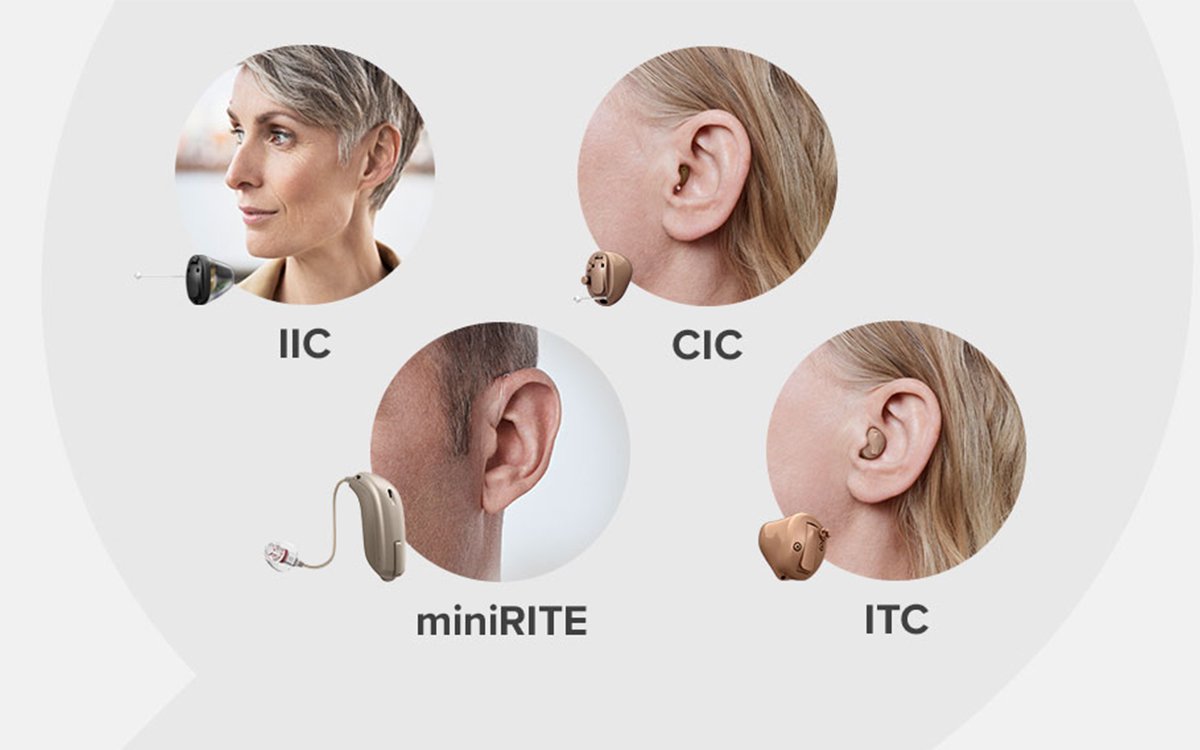
Four popular styles in this category are:
- CIC (Completely-in-Canal) – Fits deep in the ear canal, barely visible.
- IIC (Invisible-in-Canal) – Even smaller and deeper than CIC, virtually invisible.
- ITE (In-the-Ear) – Larger, fills most of the ear bowl, easier to handle.
- ITC (In-the-Canal) – Mid-sized, partly fills the ear canal opening.
These hearing aids appeal to patients who want a combination of cosmetic appeal, comfort, and personalized sound quality.
Hearing demands, ear anatomy, lifestyle, and physical dexterity all play a role in making the best decision.
In this article, we’ll go over how each style works, their benefits and drawbacks, who they’re best suited for, upkeep, prices, and how they compare to other hearing aids such as RIC and BTE.
- How These Hearing Aids Work
Although the size and placement vary, all in-the-ear hearing aids have similar components:
- Microphone – Captures sound from the environment.
- Amplifier/Processor – Adjusts sound to match your hearing prescription.
- Receiver (Speaker) – Sends the processed sound into your ear.
- Battery or Rechargeable Cell – Powers the device.
The biggest difference is how deep the device sits in the ear, which impacts visibility, sound quality, and comfort.
- Completely-in-Canal (CIC) Hearing Aids
[Put CIC hearing aid picture here]
- Placement: Sits deep inside the ear canal, with only a tiny removal handle visible.
- Best for: Mild to moderate hearing loss.
- Advantages:
- Very discreet – barely noticeable in most people.
- Natural use of the ear’s shape for sound collection.
- Less wind noise.
- Drawbacks:
- Small size means limited battery life.
- May not fit in very small or unusually shaped ear canals.
- Lacks some advanced features due to space limitations.
- Invisible-in-Canal (IIC) Hearing Aids
[Put IIC hearing aid picture here]
- Placement: Fits even deeper than CIC, sitting just millimeters from the eardrum.
- Best for: Mild to moderate hearing loss, especially for patients who want maximum invisibility.
- Advantages:
- Virtually invisible to others.
- Uses natural ear acoustics for sound localization.
- No interference with glasses or hats.
- Drawbacks:
- Very small – can be harder to insert/remove.
- Short battery life.
- Not suitable for severe hearing loss or certain ear canal shapes.
- In-the-Ear (ITE) Hearing Aids
[Put ITE hearing aid picture here]
- Placement: Custom-molded to fill most of the outer ear (full-shell) or just the lower half (half-shell).
- Best for: Mild to severe hearing loss.
- Advantages:
- Larger size = easier to handle and operate.
- Can include advanced features like directional microphones, Bluetooth streaming, and telecoils.
- Longer battery life.
- Drawbacks:
- More visible than CIC/IIC.
- More wind noise than smaller in-ear models.
- In-the-Canal (ITC) Hearing Aids
[Put ITC hearing aid picture here]
- Placement: Fits partly in the ear canal and partly visible at the canal opening.
- Best for: Mild to moderately severe hearing loss.
- Advantages:
- Good balance between visibility and features.
- Can include directional microphones.
- Easier to insert/remove than CIC or IIC.
- Drawbacks:
- Smaller than ITE, so slightly shorter battery life.
- Still more visible than CIC/IIC.
- Advantages of In-the-Ear Styles as a Group
- Custom-fit for comfort.
- Many can be color-matched to skin tone.
- Easier phone use without feedback.
- Stable in the ear during normal activities.
- Challenges and Limitations
- Susceptible to earwax and moisture damage.
- Smaller models limit feature availability.
- Not ideal for children due to ear growth.
- Can be harder to handle for people with dexterity issues (especially CIC/IIC).
- Fitting Process for ITE, ITC, CIC, and IIC
- Hearing Test – Determines hearing thresholds.
- Ear Impression – Mold taken to ensure a perfect fit.
- Device Programming – Tailored to your hearing loss.
- Insertion Training – Audiologist teaches proper insertion/removal.
- Follow-up Appointments – Adjustments and comfort checks.
- Maintenance and Care
[Put picture of cleaning in-ear hearing aids here]
- Daily: Wipe with dry, lint-free cloth.
- Weekly: Clean microphone ports and replace wax guards.
- Avoid: Water, hairspray, extreme heat.
- Professional Check: Every 6–12 months.
- Costs and Insurance
- CIC/IIC: $1,500–$3,500 per ear.
- ITE/ITC: $1,200–$3,800 per ear.
Prices depend on technology level, features, and customization.
Insurance coverage varies; some only cover part of the cost.
- Special Considerations
- For Seniors: Larger ITE or ITC styles are easier to handle. Rechargeable options help avoid battery changes.
- For Younger Adults: CIC and IIC offer cosmetic discretion but require good dexterity.
- For Active Users: Sweat-resistant coatings and secure fits are important.
- Tips for First-Time Users
- Start in quiet environments.
- Practice insertion/removal daily.
- Keep up with cleaning to avoid repairs.
- Use follow-up visits to fine-tune fit and sound.
- Future Trends in In-the-Ear Hearing Aids
[Put picture of modern hearing aid technology here]
- Rechargeable Batteries – Longer use time, no disposable batteries.
- Artificial Intelligence – Automatic environment adjustments.
- Health Sensors – Heart rate, fall detection.
- Improved Miniaturization – Smaller devices with more features.
- Comparison Table: In-the-Ear Styles vs. RIC and BTE
| Style | Visibility | Hearing Loss Range | Features | Ease of Handling | Battery Life | Comfort | Maintenance |
| CIC | Very low | Mild–Moderate | Limited | Low | Short | High | Moderate–High |
| IIC | Nearly invisible | Mild–Moderate | Limited | Low | Very short | High | High |
| ITC | Low | Mild–Moderate-Severe | Moderate | Medium | Medium | High | Moderate |
| ITE | Medium | Mild–Severe | High | High | Long | High | Low–Moderate |
| RIC | Low | Mild–Severe | High | High | Medium–Long | High | Moderate |
| BTE | Medium–High | Mild–Profound | Very high | High | Long | High | Low |
- Summary
CIC, IIC, ITE, and ITC hearing aids offer patients a wide range of discreet, comfortable, and effective solutions.
- CIC & IIC – Best for cosmetic invisibility and natural sound, but fewer features.
- ITC – Balance between discretion and technology.
- ITE – Easiest to handle with the most room for features.
Choosing the proper style requires balancing looks, hearing demands, lifestyle, and price.
With correct installation and maintenance, these gadgets can significantly improve communication and quality of life.


